Versions · PHW99Go
Record a Game Version Before Comparing Rules
Two tabs can use a familiar game name while showing different amounts of information. One might be a provider’s short product page; another might be an in-game help screen. Before comparing individual rules, record what each document is. This practical method keeps your notes reproducible and prevents a confident comparison from resting on an unidentified source.
Compare identified documents first. A shared name, theme or cover does not establish that two descriptions refer to the same title or rules edition.
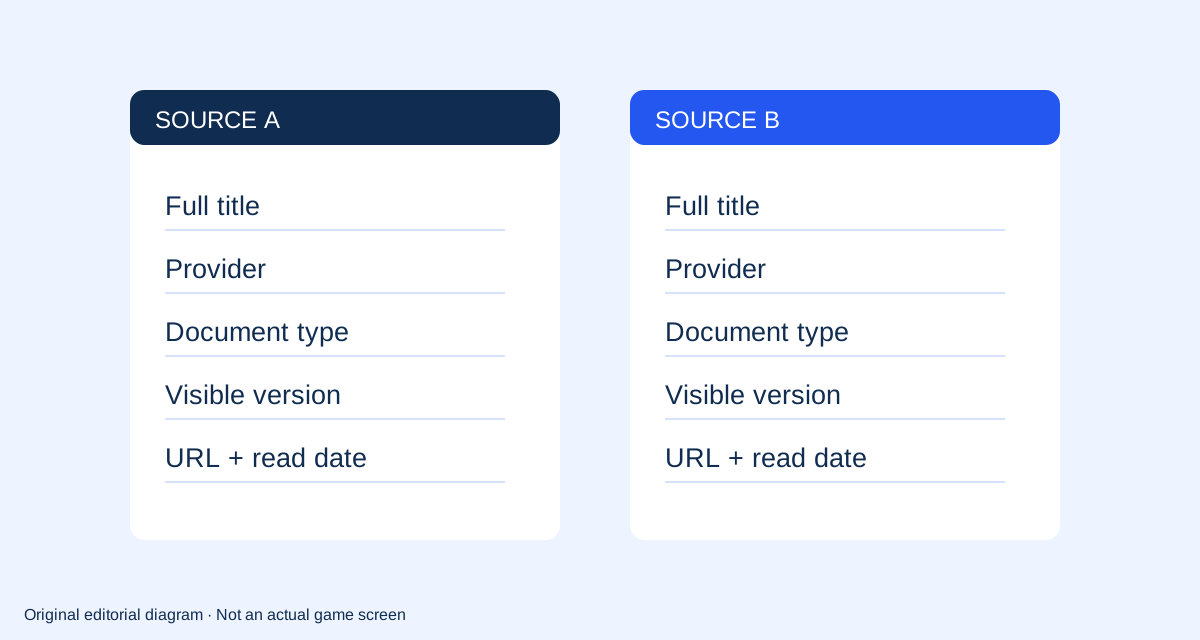
Give each source its own identity
Create one record for each page you are reading. Use the exact title shown in its heading, the provider name, the URL and your reading date. Add any visible edition or version label, but do not invent a build number when none is present. The reading date records when you checked the source; it does not establish when the game was released or last changed.
Our rules notebook provides those fields without requiring an account.
Describe the document’s job
Label the source as a product overview, dated announcement, rules page, help screen or your own screenshot. These labels tell the next reader what they can expect to find. A short promotional overview may name a feature without listing every exception. A dated announcement is useful historical evidence, but it should not be presented as a current operator configuration.
For example, Pragmatic Play’s Wild West Gold announcement is dated 26 March 2020. Preserve that date when using it as a source.
Separate “not mentioned” from “different”
If source A names an exception and source B says nothing about it, you have an information gap. You have not yet proved the exception was removed. Write the exact point that needs another source. A reliable comparison can say that one document is less detailed than another without claiming that the underlying software behaves differently.
The same discipline applies to numbers. A percentage omitted from an overview is not a zero percentage, and an unlabelled number is not automatically an RTP.
Compare one claim at a time
Use a small comparison table with three columns: the question, what each source says and what remains unresolved. Suitable questions include “Which symbols are excluded?” or “When does the described multiplier apply?” Avoid a single broad verdict such as “same game” when only one feature has been checked. Each answer should be no wider than its evidence.
Keep the document names visible above the table so a quoted sentence cannot drift away from its title and provider.
Preserve the boundary of the example
Official product pages are valuable named references, but they are not a certificate for a remote lobby entry. Play’n GO’s Book of Dead page describes an Expanding Symbol feature for that title. It does not identify the configuration of an unrelated installation merely because the artwork looks familiar.
Finish your record with a sentence stating what you checked and what you did not. A useful example is: “Compared two public descriptions; did not access a live game or verify server behaviour.” That limit makes the record clearer, not less useful.
Your reading checklist
- One record per source
- Document type identified
- Read date kept separate from release date
- Silence not interpreted as a changed rule
- Conclusion limited to the checked claim
Reader questions
Should I fill an absent version label from another website?
No. Record that it was not shown in the source you checked. A third-party label needs its own evidence.
Does a screenshot establish the current version?
Only if the necessary identity and version details are actually visible and their context is known. Otherwise it is a partial record.
Sources and scope
- Pragmatic Play — Wild West Gold release announcement
Dated 26 March 2020; examples of a Wild multiplier, Scatter trigger and Sticky Wilds for this named title.
- Play’n GO — Book of Dead official product page
The named title’s Expanding Symbol feature; no inferred RTP, licensing or configuration for an operator.