Features · PHW99Go
Compare a Demo with a Rules Page
The word “demo” can refer to several different things: an interactive free version, a recorded feature clip or an illustration on a product page. Those are different types of evidence. Before using a demo to interpret rules, decide what is actually being shown and keep the comparison tied to the named title and source.
A demo can show an interface or illustrate a feature. A short sample cannot establish the underlying probabilities, the current configuration of another service or a future result.
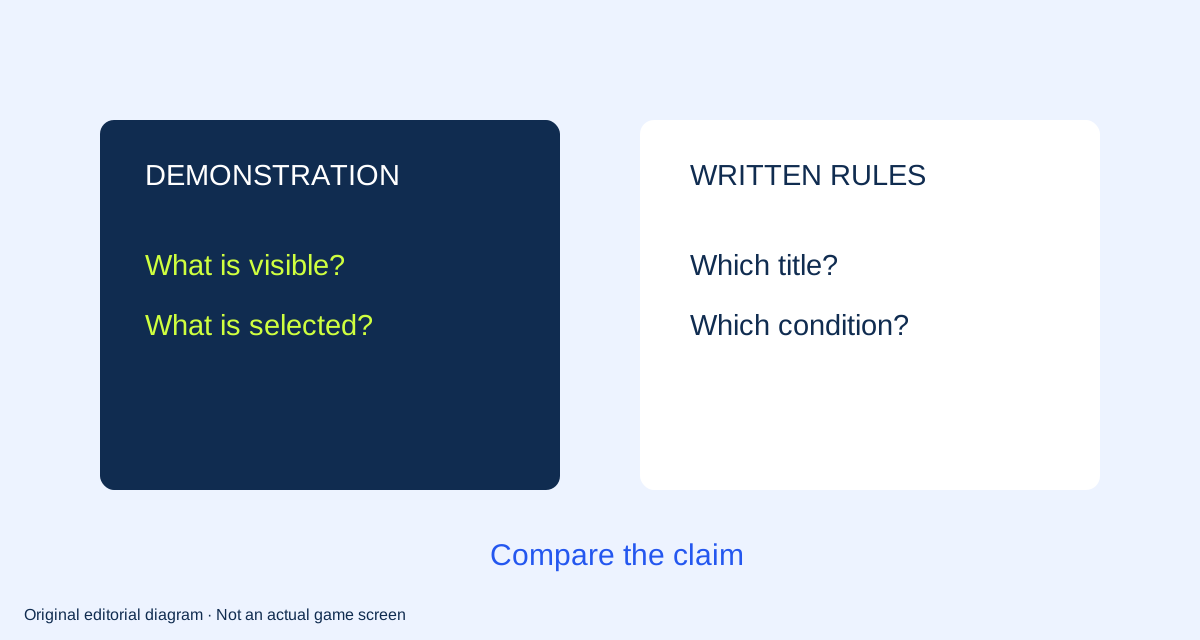
Name the demonstration format
Start your note with a plain description: interactive free version, video, screenshot or editorial diagram. If the publisher labels a clip as edited, accelerated or feature-focused, keep that label. Do not silently turn a demonstration into a record of an ordinary session. A feature montage can explain what a screen looks like without showing how frequently the screen occurs.
Our illustrations are original explanatory diagrams, not captures from a working game.
Match the documents before the feature
Record the demo title, provider, source URL and any visible version label. Repeat the same process for the written rules. If either identity is missing, describe that limitation before comparing individual symbols or feature names. A provider’s overview and an operator’s implementation should not be assumed identical merely because both use a familiar name.
Keep the source types separate in the version record.
Keep a publisher’s notice within its scope
The Play’n GO Book of Dead public page carries a notice that its games require no purchase and offer no real money. That notice belongs to the publisher’s own public site. It does not describe the terms of another website, establish another installation’s configuration or certify an operator. Keep the publisher, page and notice together in your record.
The practical question for your note is narrower: what does this source claim to demonstrate, and what evidence have you actually checked?
Compare observable details
Useful observations include the visible symbol label, the name of a panel and whether a described message appears in the example. Write them as observations, with the source and context beside them. Do not convert a few observed outcomes into a published probability. A sample that happens to include a feature may have been chosen precisely because it illustrates that feature.
Similarly, a short sample without a feature cannot establish that the feature is absent from the rules.
End with a bounded conclusion
A careful comparison might conclude: “The named product description includes this feature; this clip illustrates its appearance; the clip does not establish frequency.” This is more informative than a broad claim that the game is verified. The Australian Institute of Family Studies explanation distinguishes long-run RTP from an individual player’s results. A demo sample does not remove that distinction.
If you only wanted to understand the document, there is no need to continue into registration, a deposit or play. Save the reading note and leave unresolved configuration questions unresolved.
Your reading checklist
- Demo format identified
- Named sources matched
- Promotional editing labels retained
- Observations separated from probabilities
- No claim of operator or jurisdiction approval
Reader questions
Can a demo establish RTP from a few rounds?
No. A brief sample does not establish the underlying long-run percentage. Record it as an observation, not a probability estimate.
Is an official demo proof that a different website is approved?
No. Provider identity, implementation and operator approval are separate questions. This comparison establishes none of them for an unrelated service.
Sources and scope
- Play’n GO — Book of Dead public demo description
The publisher’s own public-site no-purchase and no-real-money notice; not certification of another website.
- Australian Institute of Family Studies — understanding long-run return
Research explanation of long-run RTP and variation in individual results; not a forecast for a session.